
VEVOR 13-Inch 1800 W Planer Review: The Cheaper Two-Blade Unit

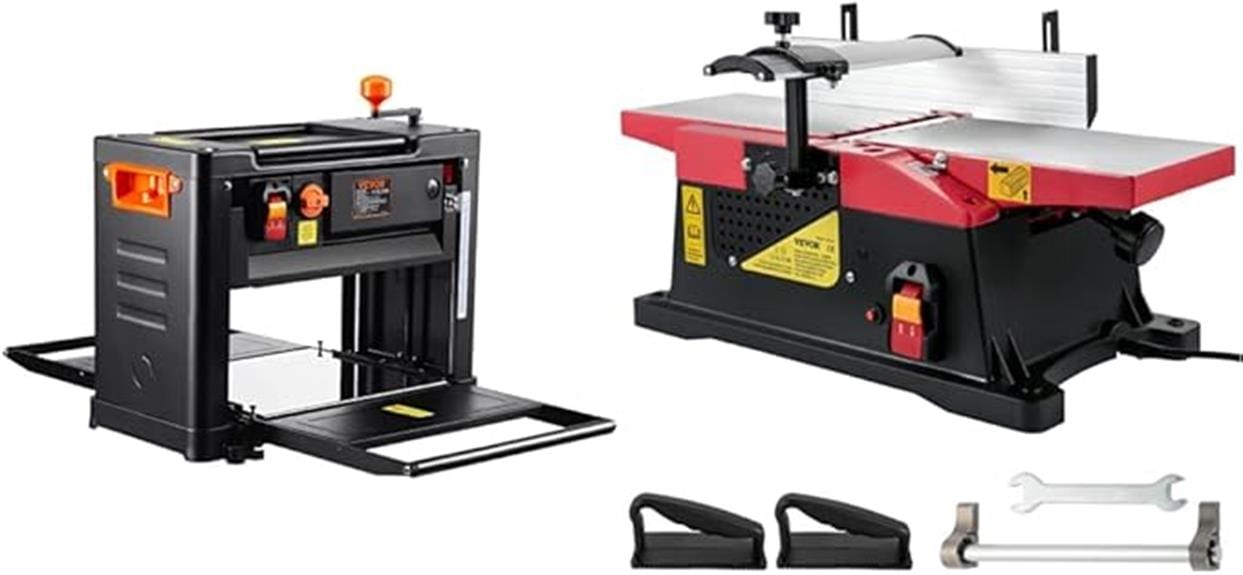
The VEVOR 13-inch 1800 W planer is the cheaper half of VEVOR’s 13-inch range: a two-blade, single-speed machine that ships with a folding stand and dust fittings. It costs about fifty dollars less than the three-knife version and it asks you to accept a coarser cut in exchange. This page explains exactly what that trade costs in a home shop.
Specifications and prices come from the manufacturer’s current listing. We do not claim lab measurements, and ratings quoted are the listing’s own at the time of writing.
Main Points
- 15 A / 1800 W motor driving a two-blade head at 8,000 RPM, with a single feed rate of about 6 m/min.
- 13-inch width and 0.2 to 6.3-inch thickness range — the capacity is the same as the more expensive model, and slightly deeper.
- Two double-edged HSS blades can be flipped and reused before replacement, which halves the cost per edge.
- Folding stand included, plus foldable extension plates and two return rollers. At this price that is a real part of the value.
- Expect to sand more. Two knives at 8,000 RPM leave more visible knife marks than a three-knife head, and there is no slow feed to smooth the final pass.
Quick Specs & Price Check
| Item | Figure |
|---|---|
| Motor | 15 A, 1800 W |
| Cutter head | Two double-edged HSS blades, 8,000 RPM |
| Feed | Single speed, 236 in/min (6 m/min) |
| Max width | 13 in (330 mm) |
| Thickness range | 0.2 to 6.3 in (6 to 160 mm) |
| Table | Metal workbench with foldable extension plates, two return rollers |
| Stand | Detachable folding iron stand |
| Dust | 45 mm inner / 50 mm outer port, dust bag, iron cover alternative |
| Safety | Electromagnetic power-off switch, over-current protector |
| Price | Around $307 |
| Customer rating | 4.3 / 5 from 286 ratings |
Why This Product Stands Out
The stand. Most planers in this price bracket arrive as a bare box and expect you to build a bench for them or pay another hundred for a stand. VEVOR ships a folding iron stand in the box, and the machine has ABS grooves on both sides so two people can lift it on and off without improvising.
Then the blades. Double-edged HSS means each blade gives you two cutting edges before it needs replacing. On a two-blade head that is four edges per set, which stretches the consumable cost considerably if you plane a lot of rough stock.
The capacity is the other reason this model exists. Thirteen inches wide and 6.3 inches thick is the same working envelope as the more expensive VEVOR, and a touch deeper at the top end. If your work is dimensioning glued-up panels and reclaimed boards rather than chasing a furniture-grade finish straight off the machine, the extra knife and the second speed buy you less than the stand does.
Build and Setup
The bed is metal, not cast iron, and the extension plates fold rather than slide. That is where the money went: the stand and the folding hardware replace the cast bed and the pull-out extensions of the three-knife model.
The crank handle adjusts cutter head height, and there is a scale ruler on the machine. Treat the ruler as a guide and set final thickness with calipers on an offcut.
Plan for the assembly to take an evening. The stand, the extension plates and the dust fittings are all separate pieces, and the machine is heavy enough that putting it together alone is a bad idea.
Dust collection is not optional in practice. The port accepts a 45 mm hose with a 50 mm outer collar, and VEVOR includes a bag and an iron cover for the port. A bag catches chips; it does not stop fine dust. If the planer lives in a small shop, run it to a vacuum.
Performance: What the Numbers Mean
Eight thousand RPM with two knives is roughly 16,000 cuts per minute. The three-knife model runs 23,500 RPM with three knives, which is more than four times the cuts per minute. That is the honest comparison, and it explains the two things owners notice: this planer is slower to a finished surface, and it leaves more visible knife marks that have to come out with a sander or a hand plane.
For construction-grade work that does not matter. For a table top it does.
The single feed rate is the other limitation. On figured wood, the usual technique is to slow the feed for the final pass so each knife takes a shallower bite and tear-out drops. This machine does not offer that adjustment, so you either take very light passes by raising the head in small increments or accept some tear-out and deal with it downstream.
What the machine does well is remove material predictably from boards that are too wide for a jointer and too rough for a hand plane. The two return rollers are a small thing that saves a surprising amount of walking.
Who Should (and Shouldn’t) Buy This
Buy it if you are planing rough lumber down to size, your finishing happens with a sander anyway, and the folding stand matters because your shop shares space with a car. At this price, with a stand in the box, it is one of the cheaper ways into 13-inch capacity.
Skip it if you are making furniture that will be finished clear, straight off the planer. The knife marks and the lack of a slow feed will cost you more time in sanding than you saved on the machine.
Skip it too if you already own a three-knife planer of any brand. There is no reason to step down.
Top 3 Competitors Compared
- VEVOR 13-inch three-knife — the model above this one: 2000 W, three knives, two feed speeds. Fifty dollars more and a genuinely better surface. This is the comparison that matters.
- WEN PL1326 — three blades, 13 inches, similar money. No stand in the box, better finish off the machine.
- DEWALT DW735X — the reference machine in this size. Twice the price, and worth it if you plane hardwood every week.
For the full range side by side, see the best VEVOR planers.
Final Verdict
This is a dimensioning tool, not a finishing tool. It takes rough boards to thickness reliably, it comes with a stand that would cost you a hundred dollars separately, and it leaves a surface that needs sanding.
If that is the job you have, it is good value at around $307 and the 4.3 rating across 286 reviews is consistent with that. If your job is a finish-ready surface, spend the extra fifty dollars on the three-knife model — the second speed and the third blade are the whole difference.
Frequently Asked Questions
Does the stand come included?
Yes. The folding iron stand ships with the machine, along with foldable extension plates and two return rollers.
Can it plane hardwood?
It can, at lighter passes. The limitation is not the motor but the cut quality: two knives at 8,000 RPM leave marks that show up under a clear finish. Hardwood furniture work is better served by the three-knife model.
Are the blades replaceable?
Yes, and they are double-edged, so each blade can be flipped once before replacement. Replacement sets are widely available and inexpensive compared with proprietary knife systems.
What size dust hose fits?
The port is 45 mm inner diameter with a 50 mm outer collar, which matches most shop vacuum adapters. A bag is included for chip collection.
This is also interesting